Excerpt


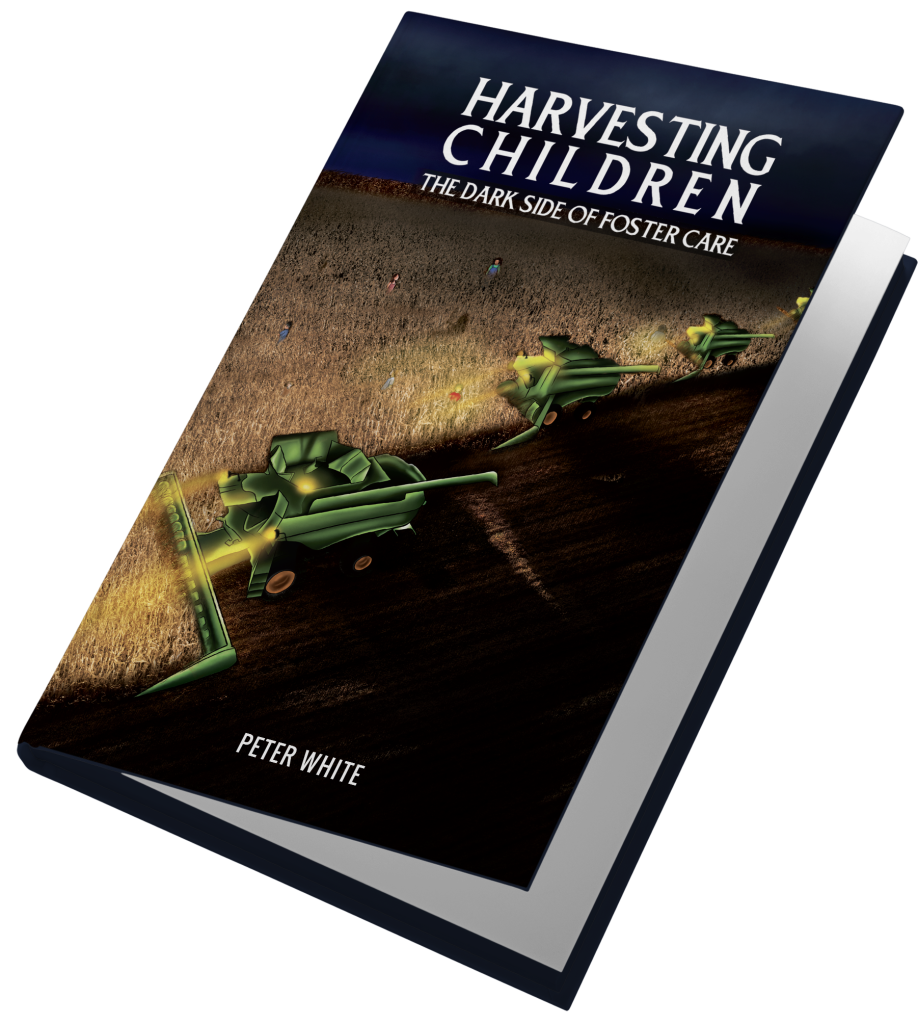
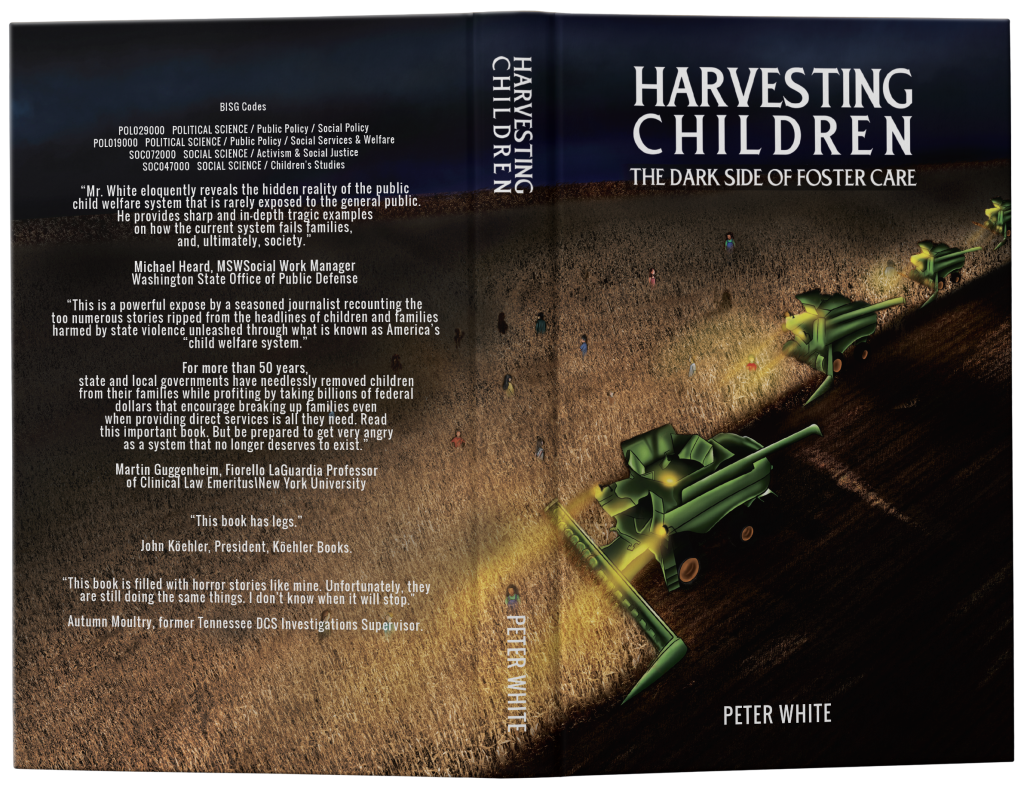
The stories in this book describe families in crisis and what happened to them. They were originally published in The Tennessee Tribune from August 2021-2022. Tennessee’s Department of Children’s Services (DCS) operates a $1.4 billion/yr. child trafficking network and Harvesting Children details the involvement of its many players.
I started investigating the Tennessee Department of Children’s Services (DCS) after an internal survey of DCS employees was leaked to the press. I did a few stories about DCS employees and readers left comments that led to other stories about families. People contacted me via email or left messages at the office. Pretty soon I was overwhelmed with parents and grandparents asking for help. The more stories I wrote the more leads I got but couldn’t keep up with them all.
People were eager to talk. DCS officials were not. Official obstinacy and their unwillingness to answer questions made my investigations difficult and the process changed me. I have become an advocacy journalist for the families and the children caught up in the child welfare system.
I wrote this book to tell their stories, to give them a voice, and to understand how such horrible things happened to them. This book also looks at the child welfare system and the people who run it.
For me it is also a personal exorcism. I lost custody of my kids in a nasty divorce and they grew up with a mother who turned them against me. They are young adults now but the parental alienation they endured is still with them. The anguish of not seeing them grow up is still with me, too. A black father who lost his daughter told me, “You never get over it.” Like the victims in this book, I know what it is like to be caught up in a system that treats people with contempt who come before it seeking justice.
There are two theories about child welfare agencies. Do they rescue neglected and abused children from their deadbeat parents? Or do they run a state security service like a modern-day version of the former East German Stasi? This book takes the latter view. I think in many ways DCS is worse than the ills of abuse and neglect it is supposed to cure.
Academics have studied child welfare to death. Auditors have issued damning reports ad nauseam, and year after year, politicians keep throwing money at child welfare agencies; courts issue consent decrees to force them to improve; nonprofits invest time and money; reporters like me write countless articles chronicling child welfare scandals in the U.S.
This book explains how and why these agencies fail. Politicians, scholars, and welfare officials often claim that family reunification is, or should be, child welfare’s primary goal. But these agencies spend extraordinary amounts of money taking children away from parents and succeed at reuniting them only about half the time.
In Tennessee, most of the $1.4 billion Child Welfare budget goes to pay employee salaries. A second big chunk goes to service providers who have state contracts worth millions. Many are non-profits or church-related.
Tennessee is a deeply red state where churches (11,089) outnumber places that sell liquor by the drink (4,613) by two to one. Whisky and salvation have battled here for 150 years. These days, drugs have been substituted for the demon drink of yesteryear and if you use or fail a drug test, the Department of Children’s Services (DCS) will take your kids away.
According to Richard Wexler, Executive Director of National Coalition for Child Protection Reform, the major problem with child welfare agencies in the U.S. is that they are carceral systems. Like prisons, they rely on hyper-surveillance to wrongfully take children and prosecute parents who are mostly poor.
This view is held by a growing number of researchers, who say Black children are more likely to be removed from their homes and put into foster care than White children. They are also less likely to be reunited with their families. There is a long- standing debate whether this is because of racial bias or because Black families are more likely to be poor and more likely than White families to mistreat their kids.
“It can’t stay the same,” Reguli says. “I have grandchildren, you know? And I know that being vulnerable in the United States does not necessarily mean you have a physical or mental disability. You can be vulnerable if you are a victim of domestic violence, if you are poor, if you are a single mom or a single dad. The bell curve for vulnerability is pretty broad, so vulnerable families are at risk.
As you will discover in this book, Connie Reguli has become one of the leading voices, an outspoken advocate demanding change.
“Change comes not just from a voice but from propelling the message across a broader spectrum,” Reguli told me. She thinks it will take powerful discussions across many segments of American society to transform the child welfare system.
“Social systems in America have changed but until we look at the systemic problems, we can’t effect that change,” she says.
“I mean why is it all going so wrong? All the results are bad from this 1974 law. The results are bad for foster children. The results are bad for families. The results are bad financially. The results are all bad. We know that. So, we need a change but until we look at the systemic categories of problems we can’t effect that change,” Reguli says.
In any case, the child welfare system has failed to resolve racial disproportionality and disparities for many years. Academics, family advocates, and others are calling for the abolition of child welfare as we know it. I am among them.
The premise behind Harvesting Children is that the state doesn’t parent well and should stop trying to. DCS and its cohorts are not saving abused children as much as punishing their parents. Once kids are put in foster care, the state can start collecting child support from their parents. DCS has custody, so by law they are entitled to it.
DCS caseworkers can’t do a decent job because they have too many cases and too much paperwork. They get reprimanded or fired if they fight too hard for families they are trying to help.
The juvenile court judges who preside over these cases sign emergency removal orders on flimsy or sometimes falsified evidence that provide legal cover for DCS to wrongfully take children from their families before any trial begins.
When most parents go to court, their kids are already gone, and getting them back, if they ever do, is an Orwellian nightmare. The process is rigged and parents navigating the system face a culture of lying that permeates the department from top to bottom.
The bad actors in this book are identified by name and title. They believe anything is better than the severe abuse or neglect kids supposedly are exposed to before the state takes them away. But these cases rarely involve violence, and the “neglect” often is due to poverty.
Families whose children have been taken are lucky to get them back. DCS sues the others to terminate parental rights after 15 months in custody. Under the Social Security Act, the Title IV-E program was created in 1980 as part of the Adoption Assistance and Child Welfare Act. The federal government reimburses states for half the cost of adoptions. For every adoption, states collect a payment. To stop paying these bounties, Congress would have to change the law.
Child welfare has a withering cast of characters who are all invested in a dysfunctional system. This includes lawyers, guardians ad litem, judges, social workers, congregate care operators, foster parents, adoptive families, non-profits, dentists, doctors, therapists, and psychiatrists. These people get involved when the state wants to terminate parental rights.
Family law attorney Connie Reguli describes one such scene in Nashville when she counted seven state functionaries along with the judge and his clerk clustered in the front of the courtroom. Against the phalanx of taxpayer-supported strangers trying to take their children, stood the mother and father and Reguli, their attorney. Three against nine. Doesn’t sound fair, does it? It isn’t.
We have to understand that the system is broken and the problems are systemic. These stories are not purely academic. One family is affected here and one family is affected there. But these stories are repeated over and over and over in every community and every state. They reveal problems that are affecting families all across the country.”
Child welfare authorities in the U.S. are removing staggering numbers of children just like church and civil authorities did a century ago with American Indian children and like Canadians did with their First Nation children. The rationale was as bogus then as it is now.
The reason so many kids get taken is because their families don’t have the money to defend themselves with a good lawyer. They aren’t middle class like the people who are prosecuting them or the people who rush to stereotype impoverished parents as sick or evil and, therefore, should have their children taken from them.
But once taken, most do not thrive in foster care. Being a foster child can be like playing a demented game of musical chairs. In 2021, DCS moved 1,612 children once, 818 twice, and 740 children three or more times. Many of them become maladjusted adults who are psychologically disturbed and end up in prison once they age-out of the system.
Compared to their peers, foster kids are seven times more likely to experience depression, six times more likely to exhibit behavioral problems, and five times more likely to feel anxiety.
Researchers have investigated every aspect of child welfare to find out what is wrong and why it is so bad. The best answer policy wonks can offer is that various unnamed sources “lack the political will” to “do what should be done”, by which they usually mean, enact major reform and stop throwing even more money into policing families.
We are always hearing that there aren’t enough foster parents, group homes, and adoptive homes to house all the kids DCS takes. The solution is quite simple: stop taking so many kids into custody, provide wraparound services to families, and return the kids to their parents quickly. In the Volunteer State, none of those things is happening with any consistency.
The $1.4 billion DCS budget should be redirected so families get the social services they need. DCS offers services to families it controls but uses a carrot and stick
approach that is cruel and ineffective. Imagine how ambivalent parents must feel when DCS offers help while simultaneously trying to take their children away forever.
What DCS says it does is often at odds with what it actually does. DCS is hopelessly conflicted about its core mission: should it be reunifying families or should it be getting as many children adopted as quickly as it can? Most, if not all, child welfare agencies in the U.S. are similarly conflicted.
Two things have become abundantly clear: children who spend too much time in custody are not served well and most state agencies that manage foster care have been failing to do it well for the last 60 years. Of course, some are better than others. There are a handful of states using a holistic and multidisciplinary approach that lessens the time spent in foster care and increases family reunifications.
However, it’s doubtful things will change any time soon in Tennessee. The department should be dismantled and rebuilt from the ground up with completely different leadership. The last two DCS Commissioners spent years in the criminal justice system but not a single day as social workers. A good system should be transparent, which DCS is not, and it needs to stop punishing parents by devoting itself to helping families stay together.
I would like to thank Connie Reguli, Richard Wexler, Maleeka Jihad, aka MJ, Melaniia Jordan, Michael Heard, and activist Joyce McMillan for educating me about child welfare. Their experience and insights are present throughout these pages. Judge Sheila Calloway and Magistrate Mike O’Neil and Juvenile Court Clerk Lonnell Matthews helped me understand the role of juvenile courts in child welfare cases. Jessica Ramsey provided invaluable insight about Guardians ad Litem and Senator Ferrell Haile described baby courts, one good thing that is actually helping drug- addicted mothers turn their lives around in Tennessee. Brian Narelle titled the book. I would especially like to thank my editor, Robin Goodrow, who convinced me to share my own story. I am also in debt to the dozens of caseworkers, advocates, officials, non-profits, and families who told me their stories. I hope I have told them well and true.
Peter White
Kingston Springs, Tennessee May 1, 2024